 squad-devkit

One manager plans and checks.Cheap workers do the typing.
squad-devkit turns one terminal into an engineering team. You talk to one manager agent — it splits the work, spawns isolated workers in parallel git worktrees, and verifies every diff before merge.
- Free & open source
- macOS & Linux
- GPL-3.0
- Idle agents cost nothing
MANAGER claude-opus · plan .squad/plans/fix-session-refresh.mdguard hook: active
dev-1done
claude · haiku
squad/dev-1
Fixed null guard in auth/session.ts (+14 -3)
18.4k tok
dev-2running
codex · sandbox
squad/dev-2
Writing unit tests for token refresh edge cases
12.1k tok
reviewerverified
claude · sonnet
read-only
Diff clean · 0 regressions · awaiting merge
6.2k tok
Live preview of how squad-devkit coordinates workers without burning idle tokens.
Built for real repositories
Every design choice keeps token burn low and your git history clean.
Fewer tokens, zero idle cost
Workers start only when there is scoped work and exit as soon as they report back. Nothing polls in the background while idle.
Isolated git worktrees
Every editing worker runs in its own git worktree and branch, with enforced file ownership so parallel edits never collide.
Live Squad Deck
A clean observe-only dashboard docks inside Claude Code, showing each worker's state, model, tokens, and current step per tab.
Verified before merge
The manager reads every diff, reruns your test suite, and catches stalls or time limits before anything lands in your repo.
Steer from your phone
Connect a Telegram bot to check progress, answer worker questions, and approve commits from anywhere.
Your choice of engine
Mix Claude, Codex, OpenCode, and Grok — match the cheapest capable model to each task's risk level.
Fast Rust message bus
A tiny local Rust binary (`squad`) backed by SQLite coordinates briefs, reports, and Q&A with zero external daemons.
See your squad in action
Real tmux recordings from production runs — parallel worktrees, live deck, and hierarchy mode.
How a request moves
Strict separation between planning, editing, and merging keeps every change auditable.
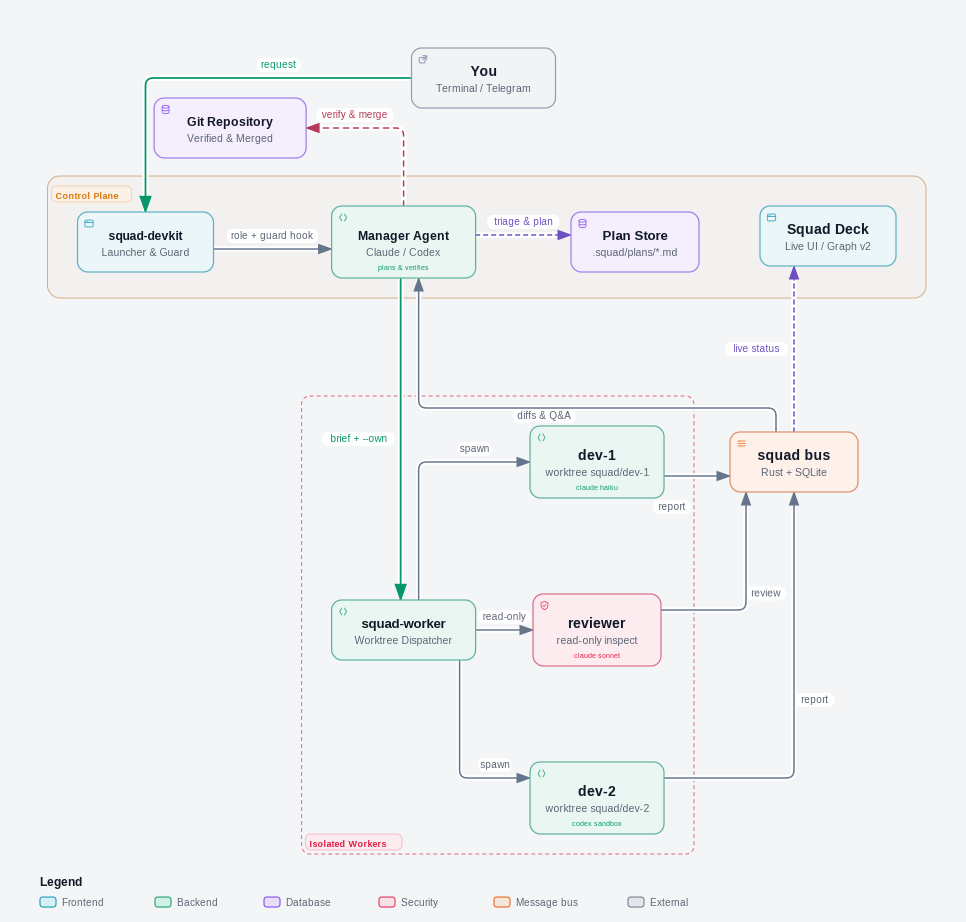
1. Triage & Plan
You give one request. The manager reads the codebase, writes a structured plan to `.squad/plans/`, and never edits project files directly.
2. Parallel Worktrees
`squad-worker` spawns each worker in its own git worktree with a scoped brief, owned paths, and time limit.
3. Diff & Verification
Workers report back through the SQLite bus. The manager inspects every diff and reruns checks; defects trigger a targeted fix run.
4. Approved Merge
Passing worktrees merge uncommitted into your workspace. A guard hook blocks `git commit` or `git push` until you explicitly approve.
Pick the right engine for each job
Spend expensive reasoning where it matters; delegate mechanical work to fast, cheap workers.
Shared Context across terminal tabs
Every `squad-devkit` tab in the same repo shares `.squad/plans/*.md` and the `.squad/messages.db` SQLite bus — keeping plans and history synced while Squad Deck filters each tab to its own workers.
Shared Skills & Role Prompts
Repo and user skills (`.agents/skills`, `.claude/skills`) plus role templates (`templates/devkit/*.md`) are automatically shared across every manager tab with zero duplicate setup.
Shared MCP with token-safe scoping
Managers access all configured MCP servers directly; workers keep context lean by disabling unused MCPs by default and enabling only what's needed via `--mcp NAME` (Codex) or workspace config (OpenCode).
| Engine | Trust level | Default / Models | MCP access | Best used for |
|---|---|---|---|---|
| claude | Highest | haiku default · sonnet / opus for complex work | Full in Manager · off in workers (lean tokens) | Work that must be right the first time, tricky refactors, and high-risk changes. |
| codex | High | Codex CLI | Scoped per worker via --mcp NAME | Everyday implementation, debugging, tests, and tasks needing MCP tools. |
| opencode / grok | Medium (experimental) | OpenCode / Grok | Via workspace CLI config | Low-risk implementation or getting an independent second opinion. |
Built on top of the upstream `squad` SQLite message bus by mco-org.
Guardrails by default
Autonomous workers are useful only when you trust the boundaries around them.
Sandboxed workers
Codex runs sandboxed to the project, and Claude runs shell commands strictly inside Claude Code's sandbox.
Manager guard hooks
A hook blocks the manager from editing project files outside `.squad/` and blocks `commit` or `push` without your approval.
Zero stored credentials
squad-devkit never stores API keys or tokens — it delegates directly to the CLIs already authenticated on your machine.
Up and running in three commands
Works on macOS and Linux with bash, git, one manager CLI, and at least one worker engine.
git clone https://github.com/bthanhtung/squad-devkit.git
squad-devkit/scripts/install-devkit.sh
squad-devkit "your request"
Make sure `~/.local/bin` is on your PATH, then run `squad-devkit --doctor` to verify your setup.